Fonts are a key way of revealing certain aspects of a film, for example Blackletter fonts could be used to reinforce the fact that the film is set in the past in Western Europe, as that is where this font style originated from. The colour of a typography can also be used to suggest aspects of a film, an example of this is that white could be used to establish a theme of purity and innocence whereas black could suggest that something is immoral and corrupt.
The first titles in the opening sequence of Inglourious Basterds use a bold serif typeface, this constructs connotations of strength and masculinity. This links with the themes of the film because it revolves around strong men fighting in World War 2. However the font is also eroded in several areas, this connotes struggle and suggests that the characters are damaged from their experiences. The use of black against white allows the font to stand out, making the audience notice it more. The central position of the titles adds to this. The dark colour also suggests power and dominance as it assists the typeface in capturing the audience's attention. Alternatively, black is often used to suggest bad intentions and is commonly the colour worn by a villain, such as Darth Vader. This, therefore, could suggest that the characters or aspects of the film are immoral and sinister.
As the actors names begin to appear they are shown surrounded by a blood splatter. This immediately draws the audience's attention to their names and connotes violence. This combined with the stereotypical military font reinforces the themes of war and death present in the film. The typeface for the actors names is written in white, this would typically connote innocence and purity but when its surrounded by blood this becomes ironic and suggests that these characters are definitely not innocent victims. When the actor's name is first shown it's the main focus of the shot, this allows the audience to focus on who's in the film. This also serves as an introduction to the characters as the focus then moves to a picture of the character/actor. This allows the audience to discover who's who before the film begins.
This is shown at the end of the titles and introduces the film to the audience. The typeface is eroded around the Nazi symbol, this could be used to shown how destructive the Nazi regime was and how much damage it caused to the rest of the world. The symbol could also be used to further emphasise the themes of the film.
The typeface used to introduce the studios is sans serif and in white, this is very simple, it could be used to reflect the killer's simplistic view of life and death and his lack of emotion when it comes to killing people. Throughout the title sequence the text moves, this could be used to mimic the killer's unstable state of mind. It could also be used to symbolise how hectic the detectives' lives have come now that they are involved in the murder's case.
This typeface is scratchy and mimics handwriting, this could link with the visuals inbetween the shot of black that show the murder removing his finger prints. This could be used to foreshadow that hands are an important aspect of the film. This shot uses reverse type which draws the audience's attention to what's written on the screen. This typeface also flickers further emphasising the theme of instability. All of this combined makes the title sequence very sinister and unsettling as we are watching are serial killer plan as we are introduced to the actors in the film. It is also very evocative as the typeface combined with the variety of images intrigues the audience and makes them start to ask questions.
The placement of the actors name as part of the book could suggest that she is part of his plans and foreshadow future events of the film, this combined with a font that mimics handwriting makes it appear as though he is writing them into his plans.
Costumes are an essential part of building characters, the director and costume designer work together closely to decide what to reveal or hide about their character. For example, a character wearing worn, plain clothes suggests that they can't afford to buy new, fashionable clothes. Costumes also act to make a character feel real and believable, this means that a character in a teen, coming of age film set in the 1980s wearing the trends of the time and the extras also dressing the same way makes you believe that the film was set in the 80s and not filmed in 2016. Another way costumes are used is to make the audience believe that the character's had a life before the film started. If the costumes aren't suitable from the time period or setting it can be jarring for the audience and make it difficult for them to immerse themselves in the film, for example, if a character from a film set in the 1800s was wearing jeans and a t-shirt it would make the film appear unrealistic and less believable. Whereas, Captain Jack Sparrow's costume in the Pirates of the Caribbean series that's worn and dirty makes you believe that he's a pirate. Therefore, a costume designer has to seamlessly blend a character into their story. In Gone Girl, Amy Dune is portrayed on the surface as the perfect wife who supports her husband, however as the film goes on we discover that she's jealous and vengeful. Her costumes are usually simple but sophisticated. For example, when she first meets Nick she is wearing a casual outfit but she still manages to catch his attention. This suggests that Amy is naturally alluring and captivating because she doesn't have to but any effort into her appearance to appeal to Nick. However, as the film goes on we discover that this look was perfected to seduce a man like Nick and she's using it to play a version of herself that's very different to the truth.
Amy's costumes often include lighter colours which is confusing for the audience because colours such as white are used to connote innocence and purity which is very different from the way Amy acts. Alternatively, that could be the point, it could suggest that as well as playing a game with Nick and the police, Amy is playing with the audience by getting them to trust her and then revealing her menacing intentions. This all links in to how intelligent Amy is as she knows exactly what she's doing and the effect that it will have. At the end of the film, Amy uses white to play into the media's view of her being a vulnerable housewife that has been taken away from her perfect home. The modesty of the nightgown also plays into this as it suggests that she is sophisticated and pure. However, the dark, scarlet colour of the blood that covers her and the dress connotes violence and danger. To the characters in the film this suggests that Amy has been through something tormenting and both emotionally and physically scarring. On the other hand, to the audience, who know that it was Amy that killed a man and that its his blood that covers her, it reveals how dangerous she is. Red is also seen as a very romantic and alluring colour. This could have been used to play into the idea that she's a femme fatale and has the power to kill a man after seducing him.
Amy also wears black on several occasions, this colour has several different connotations. Black can be used to suggest authority and power which fits with Amy's character as she is very controlling and always stays one step ahead of everyone else. Alternatively, black is also used to present evil as a lot of villains such as Dracula and Darth Vader wear black. When Amy wears black at her parents book release it could be used to suggest her anger and menace towards the way her parents have treated her. It could also be used to show that she is trying to gain control over the situation by demanding attention by wearing such a bold colour which reinforces the idea that Amy is a very jealous character as she wants the attention to be on her instead of her book counterpart.
In the film Sicario Emily Blunt's character, Kate Macer, is recruited to try and tackle the violence occurring on the US-Mexican border by hunting down a drug cartel that's responsible for the death of her team. At the opening of the film Macer is wearing her tactical amour in an attempt to take down a drug cartel. Her uniform connotes authority and power because it tells the audience that she is more than an ordinary citizen and has the strength and intelligence to be part of the FBI. It also suggests danger and violence as she is prepared to defend herself from the oncoming events. The dark colour of her uniform is also used to construct connotations of authority as black is a strong and bold colour.
When she's not on a mission Kate wears simple and practical clothes. The colour palette of her wardrobe is cold and bleak, this could be used to mimic the negative and hopeless view of society and government organisations explored throughout the film. Kate's costumes are gender neutral and she never wears anything overly feminine, this could be used to show that to move up the ranks in the FBI and be taken seriously she has had to make herself less feminine because even though society has progressed, jobs in the army and organisations such as the FBI are still traditionally male and its difficult for women to be treated equally. The plainness of her clothes and the fact that she wears little to no make-up could support this. They could also be used as part of her costume to suggest that she has no time to spend on her appearance because she's focused on her job.
To conclude, the colour and style of a costume give the audience clues about the character and their personality. Costumes can also be used to reinforce the role the character is in, for example, the red in Amy's costume mimics the way traditional femme fatales wore red and the amour that Kate wears is used to emphasise the fact that she is part of a government organisation and fights for her country. A character's costume is an essential tool in discovering more about who they are and what their motives are.
The Dark Knight Rises is the final film in Christopher Nolan's Batman trilogy, during this film a new villain, Bane, comes to Gotham and attempts to take over the city. Bane manages to temporarily achieve his goals when he defeats Batman but by the end of the film, when this scene occurs, Batman has returned and there is a plan in place to save the city from the atomic bomb Bane was going to use to destroy it. This film included the recurring cast of Christian Bale as Batman/Bruce Wayne, Michael Caine as Alfred, Morgan Freeman as Lucius Fox and Gary Oldman as Commissioner Gordon. It also includes several newcomers to the Dark Knight cinematic universe: Anne Hathaway as Catwomen, Tom Hardy as Bane, Joseph Gordon-Levitt as John Blake and Marion Cotillard as Talia al Ghul. The film was released on the 20th of July 2012 in the UK and grossed $577.7 million worldwide. It was a financial success as it over double its estimated budget but many fans felt that it fell short of the mesmerising masterpiece 'The Dark Knight'.
At the beginning of the scene a range of mid shots are used to establish the chaos that has taken over Gotham City as a result of Bane's plan. This range of shots emphasises how many people have got involved in the fight, this shows both the power that Bane has because he managed to do this to the city but it also shows how powerful people's love for their home can be as they are willing to fight with their bear hands in an attempt to save it. The lack of diversity between the peoples' clothes could be used to show that in Bane's eyes they are all the same and are insignificant. This could be used to show that antagonists in thrillers, much like the Joker in 'The Dark Knight', have little regard for humanity and they don't care about people, instead they only care about their own goals.
Throughout the first half of this scene low angle shots are used of Bane, these could be used to emphasise how much power he has over Gotham. They could also be used to reinforce the idea of how physically strong Bane is as well as how intimidating he is and his physical advantage over Batman. This breaks a convention in action Thrillers because normally the antagonist is mentally stronger than the protagonist so the protagonist then has to use their physical strength to defeat them. However, through these shots Bane's physical strength is emphasised suggesting that he doesn't need mental strength as his power comes through violence which is easily achieved through his build. This could be used to build the audience's anticipation because it makes them more equal, therefore, making the fight more intense as you don't know who will win.
The close ups of Bane allow the audience to see the emotions on his face. For example in the second shot it shows Bane searching for Batman and his eagerness to fight. However the third shot suggests uncertainty in his face as he feels Batman's strength and determination to win. Alternatively, both shots could be used to show his happiness as he watches the city tear itself apart as well as how much he enjoys fighting and competition as he scrabbles with Batman.
As the fight continues close ups of Bane as still used, however now instead of showing his confidence and strength they establish his vulnerability and weaknesses. This suddenly changes the audience's view of Bane as he goes from being a dominating and ruthless monster to a man scrambling to catch his breath and to defend himself. The close ups allow the audience to see the fear in his eyes as Batman begins to win the fight. The high angle of the second close up emphasises this as it makes Bane appear vulnerable and weak. It also reinforces the idea that he has been defeated.
When Bane and Batman fight over the shoulder shots are used to reinforce the idea that they are on opposite sides. This shot type is first used when they start to fight, as the action continues the camera zooms into where the characters are. This places the audience directly in the action, this enhances the chaos and panic of being in a fight and helps connect the audience to what's happening. The over the shoulder shots also serve to place the audience with the characters, for example, the first shot reinforces how physically dominating Bane is and makes the audience fear for Batman. However by the second shot the audience has seen how powerful Batman is and when they are positioned with him Bane becomes small and vulnerable. This could be used to emphasise the idea that Batman is a hero and not just a vigilante because he makes the viewers feel safe and protected from the way he's positioned with the camera.
The shift in power is also enhanced by camera angles, as after Batman begins to win the fight the angles of him change from being eye level, which allowed the audience to connect with him and his struggle, to low angle shots. These shots re-establish his power and determination. Alternatively, they also support the view in the film that Batman isn't a hero as he becomes vicious and menacing. This is a common theme used in film noirs as usually the protagonists has to give in to their inner darkness to defeat the antagonist. However, the rage that is evident in these shots could be considered acceptable as Batman is getting his revenge for all of the pain and destruction Bane has caused to both himself and his home city.
In conclusion, throughout this scene a range of shot types are used to influence the audience's opinion of characters and their current situation. For example, the view of Bane develops from a ruthless tyrant to a weak and defenceless man. The is used to create tension and reinforce the audience's anticipation because it makes the scene unpredictable and in turn exciting.
How is sound used in thriller movies to create tension?
Sound isused to create tension in many different ways, for example it can be used to emphasis a character's emotions or it can be used to reinforce the impact of an action. Sound helps to control the audience's emotions and is therefore very useful when it comes to building suspense.
In the climax of the film, 'The Social Network', an unsettling and sorrowful score is used to reflect the character's emotions. This is when Andrew Garfield’s character Eduardo discovers that his shares in the company have been diluted to 0.03%. It's at this point in the film that we learn how ruthless Mark Zuckerberg was whilst working to achieving his success. The soundscape includes a variety of different elements, for example it includes a voiceover from Eduardo's perspective. Eduardo is explaining the situation to the lawyers whilst the audience watches the event happen, this shows the difference between how Eduardo felt before and after the confrontation with Mark. This builds tension as through the emotions in his voice and his word choices the audience can tell that something important is about to be revealed, this builds suspension as they are captivated by the relationship between the two main characters and are curious to discover its downfall. The score is first introduced when the depth of the betrayal Zuckerberg committed is revealed, introducing it at this moment emphasises the grief and anger felt by the characters and reinforces the sense of betrayal to the audience. There are three separate parts of the score. The first part is a tense and unsettling piece of music made up of broken strings, this adds to the suspense in the scene because it's introduced just before the audience discovers what Mark Zuckerberg did to someone who was supposed to be his best friend. This piece of music also builds suspense because it reflects the uneasy atmosphere in the scene as the characters wait to discover what happened. The second part is involves a slow progression of piano keys, this piece enhances the sorrow felt by the characters due to their loss of friendship and trust. It also mimics the lawyer's reaction to their clients decisions as they realise that the man they are representing is a ruthless person that's controlled by jealously instead of loyalty and compassion like Eduardo. The third section of the score is a dark bass synth, this is introduced when Eduardo starts to get angry, this combined with the piano emphasises his emotions and makes his character appear intimidating as he threatens Mark and Sean. This adds to the suspense in the scene because it reinforces how hurt Eduardo is because he is usually a kind and quiet character but when this section of the score is used he becomes strong and menacing. This, therefore, builds tension as it emphasises the depth of the betrayal because it had the ability to change the way Eduardo acts.
In the climax of the film 'Se7en' the soundscape combines diegetic sounds with an unnerving score to build tension. During this scene the protagonists, David Mills and William Somerset think they've beaten the antagonist John Doe but then quickly discover that they were wrong and that he's still in control. At the beginning of the clip, the diegetic sound of a pocket knife being opened in heard. The emphasis on this noise forebodes violence and reinforces the danger that surrounds the characters as despite the fact they aren't using the knife in a violent way they still have to carry one to defend themselves. When Morgan Freeman's character, William Somerset, discovers the contents of the box the score is introduced, this emphasises the horror of what he has just seen and the fear that is building within him. The introduction of the score combined with the fast pace of the editing increases the tension because it connotes panic and suggests how out of their depth and lost the protagonists are. The score being played in bursts instead of a full piece of music could be used to represent the gaps in the detective's knowledge as they don't understand the man they are fighting and they still don't know the entirety of what he has done. The shouting that can be heard whilst Somerset tries to stop David Mills from listening to John Doe also constructs connotations of trepidation as the protagonists attempt to defeat the antagonist who clearly still has the upper hand despite being in handcuffs. The shouting also creates a sense of confusion and desperation which creates tension as the audience has to listen to the heroes try to scramble to save themselves with no avail as Kevin Spacey's character still has control over the situation. The calmness in John Doe's voice as he speaks whilst the other characters are consumed by fear and anxiety is very eerie and unsettling, especially as he is describing breaking into someone's house and killing their wife. This also builds tension as it emphasises to the audience how mentally unstable and immoral his character is. The use of strings in the score when David Mills' wife is mentioned represents the spike of fear felt by him when he discovers that his wife might have been caught up in the game that Doe is playing. This, combined with the distress in his voice, puts him at binary opposition with Spacey's character because unlike him David cares about other people and wants to protect them, as shown by the score and the dialogue. The volume of the score is lowered when Doe tells Mills that he killed his wife, this builds tension as it allows the audience to focus entirely on the dialogue as the information is revealed. The rhythm of the score could mimic the beat of war drums, this could be used to represent the fight between the protagonists and the antagonists. Alternatively, it could also be used to suggest the inner struggle of David as he tries to stop himself from giving into his rage and grief and therefore doing exactly what Doe wants him to do. The emphasis of the gunshots as David kills John Doe, reinforces the anger behind the action and finality of it as there's no turning back now.
This clip is from the film 'Captain America - Winter Soldier', this scene is when the real antagonists of the film are revealed. During this fight scene the soundscape is used to emphasise the force behind actions and to build anticipation. For example, at the beginning of the scene a score isn't used, the makes the audience suspicious and start to expect that something is about to happen. This is also reflected through the camera movement as the Captain observes his surroundings and realises that something is going on and that it had something to do with him. When the score is introduce it's when Rogers begins to notice small details, such as a man sweating, and becomes even more suspicious. The rhythm of the score mimics a heartbeat and could be used to suggest that the Captain is unsure and anxious to understand what is going on. The score then stops when he realises what's about to happen, this allows the audience to focus on his dialogue which builds tension as it tells them that the characters are about to start fighting and they can see that the Captain is greatly outnumbered and has nowhere to go. The diegetic sound of the Taser could be used to reinforce the idea that Steve Rogers is in the wrong time period and that he is very out of his depth and lost in the modern world seeing as he is from the 1940s. The lack of a score then adds even more emphasis to the surge of music that's introduced when the fighting starts. The suddenness of it could be used to reflect how quickly a situation can change, this then emphasises how skilled the Captain is as he immediately jumps into action and starts to fight back. The diegetic sound of the kicks and punches being thrown are emphasised, this could be used to show how strong and powerful the Captain is. This also reflected by the camerawork as it shows an elevator full of people that Rogers managed to defeat on his own. The smash of the glass could be used to further show how strong Rogers is and that it’s dangerous to cross him. There is a lull in the score when the fighting slows down but the heartbeat like section can still be heard, this could be used to mimic the pace of the fight. For example, when the fighting is in full swing the music is fast and loud but when it stops for a moment the volume of the music lowers and the pace slows down. The focus on the heartbeat could be used to suggest how exhausting constantly fight is. Alternatively, the consistency and strength of the beat could be used to enhance the idea that the Captain is incredibly determined and that he won’t give up. The lack of the full score during this section builds suspense as it allows the full effect of the character’s actions to hit the audience and it also allows them to focus on the fact that the Captain is being forced to fight someone that he trusted and thought was on his side. The diegetic sound of him kicking his shield up could be used to reinforce the power that the shield has as well as how important it is to him. The more emotional, strings used after the fighting is finished could be used to establish the idea that the Captain is hurt by what has just happened as the people that made him who he was just tried to destroy him. The fast pace of the music could also be used the reflect Rogers’ sporadic thoughts as he tries to find a way out of the situation. The smash of the glass and the noise of the impact that the Captain makes when he falls reinforces the height he has just fallen from and how painful that would be. This builds tension as it tells the audience how much danger he is in as he had to go to such extremes to escape.
During this scene from the film ‘Reservoir Dogs’ a man is
tortured by Mr Blonde whilst ‘Stuck in the Middle With You’ by Stealers Wheelers
plays in the background. This scene use a variety of sound techniques including
contrapuntal sound and silence. At the beginning of the scene there is no
underscore, this creates a similar effect to the scene from ‘Captain America –
Winter Soldier’ as the audience starts to anticipate that something important
is about to happen. The lack of a score also allows the audience to focus on
the dialogue and the tension that it’s building between the characters. The
shouting of the victim in this scene also serves to build the suspense because
it establishes how scared and desperate he is as he knows that there’s no easy
way out of the situation. The diegetic sound of the slap is used to emphasise
Mr Blonde’s strength as he does it easy but it makes a loud noise. This focus
on violence could be used to foreshadow the future events of the scene and to
forewarn the audience that action is soon to follow. As Mr Blonde slowly pulls
on the duct tape the sound can be heard, this slow pulling is unnerving and
builds tension as it unsettles the audience. Mr Blonde’s dialogue is also disturbing
as, much like John Doe, he discusses awful acts like torture calmly and casually.
This could be used to show the audience that he is disconnected from society,
similarly to most antagonists in thrillers, and has little care or regard for
other people’s lives. This, therefore, builds suspense as the audience discover
how cruel he is because he’s torturing the man for fun instead of a means to an
end. The grating sound of the chair scraping against concrete as the victim
attempts to escape reinforces the idea that Mr Blonde is immoral because he is frantic
to get away as he knows that whatever Mr Blonde decides to do it will be
extremely painful and both mentally and physically scarring. The use of
contrapuntal sound as Mr Blonde prepares to torture the victim is unsettling
and makes the audience uncomfortable. This is because the song is very happy
and upbeat which is in complete contrast to the horror of violence. The song
could be used to reflect the joy that Mr Blonde gets from causing pain to
others, further emphasising how corrupt he is. The fact that the contrapuntal sound is also diegetic could suggest that Mr Blonde is mocking and further antagonising his victim by dancing in front of him and appearing happy before giving him life changing injuries. As the song plays the camera
pans away from the characters but groans of pain can still be heard, this tells
the audience that something big is happening without showing them. Not allowing
the audience to see and only letting them listen builds tension because the audience
have no idea what Mr Blonde is doing to hurting the victim. The happiness in Mr
Blonde’s voice when he’s finished and the camera returns to the characters
reinforces just how evil his character is. In conclusion, sound is used in many different ways to build
tension, it can be used to reinforce emotions or to unnerve the audience. Sound
adds emotions to scenes that can’t be added by visuals or dialogue by itself.
Film Noir is a cinematic style that is recognisable by its
pessimistic and dark themes. It originated in the 1940s after the Second World
War and it reflects the paranoia and scepticism that was present in society at
the time. Without the war film noir never would have existed, writers and
directors fed off the darkness created by WW2 and the horrors that people had
seen.However, it couldn’t survive the
1950s because people wanted something more hopeful and positive. The
conventions of film noir include: shadows, the theme of fate, murder,
chiaroscuro lighting, canted angles and rainy streets. These all link into the
melancholy atmosphere of film noir. There are also several key character types
that are present in film noir. For example, there is the femme fatale, this is
usually the main female character that the protagonist falls in love with.
These women seem to be ordinary but they have dark pasts and their loyalty lies
with the antagonist of the film. This commonly leads to the protagonist being
framed by her or tricked into committing a serious crime. The protagonist is
usually as man who has no future and is an underdog. This reflects the way many
men felt after experiencing the war.
In film noir the protagonist is usually a male detective or
private eye, this alienates them for society and creates a feeling a social
estrangement. A common trope of the protagonist is amnesia, this further
excludes them from society as they struggle to rediscover their memories. They
also work in dehumanising areas such as red light districts or desolate office
buildings, the cities they live in are metropolises full of corruption and
criminals. The protagonist often gets caught up in the crime that dominates
their city. Often, these men don’t have a future and they are doomed from the
beginning of the film. This reflects the way many men felt after WW2 because
the world they knew had been destroyed and they were left trying to put the
pieces back together. These cynical and obsessive men struggle to survive and
ultimately they lose this battle.
The antagonist of a film noir is usually a corrupt
politician or gangster. They are cold blooded and have little regard for other
people or how their actions affect them. They are the main source of violence
in the film and often have an air of charisma surrounding them. A common motive
for the antagonist is money because it was the main way to get ahead in a world
full of poverty. The antagonist can also have had a previous or current
relationship with the femme fatale. An example of an antagonist in film noir is
Harry Lime.
An example of a male protagonist in film noir is Holly
Martins from The Third Man. Holly is a pulp writer who has travelled to Vienna
after receiving news of the death of his friend Harry Lime. Holly quickly gets
caught up in the mystery of his friend’s death and falls in love with the
film’s femme fatale Anna Schmidt.
Holly Martins is an unusual protagonist because even though
his writing can alienate him from society he lacks the darkness that is
commonly associated with the male lead of a film noir. Instead he is a fool
that easily falls in love, however, his erratic temper and final decision could
connect him with other protagonists. Martin’s decision to kill Lime at the end
of the film isn’t unusual for the protagonist of a film noir. By doing this
Martins believes he is doing the right thing but in the end it costs him Anna
Schmidt and his innocence. Martins often confuses fiction with reality and his
disillusion is shown at the end of the film when he believes that Anna would
still want to be with him after he killed her old lover.
Harry Lime, Martins “dead” friend was part of a crime ring
that sold diluted penicillin that killed several people, including children.
Lime is an example of a cold hearted antagonist, when Holly is close to
discovering information about Harry from a doorman, Lime has him killed. This
shows that he doesn’t care about the lives of others, instead he is only
concerned by his own wellbeing. Lime also has no regrets about the deaths that
he has caused, this shows his detachment from society because he can’t
understand the guilt that he should feel.
During this scene Holly and Harry discuss the deaths that
Harry has caused and his indifference towards his actions. Lime tries to reason
with Martin, saying that the people he has killed are inconsequential and
meaningless compared to the amount of money he could make off of their deaths
but Holly isn’t convinced. During this scene we discover that Harry’s motive is
money, this establishes Harry’s disconnection from humanity and his callous
view of society because he doesn’t care about the peoples’ death, only the
money he can gain from it. Lime is transparently evil and could be interpreted
as Lucifer like as he tries to tempt Holly into committing unforgivable sins.
The protagonist of Kiss Me Deadly is Mike Hammer, he is a
private eye whose trademarks are brutish violence and a ruthless pursuit of
criminals. Hammer is a typical male protagonist of a film noir because he is
dark and brooding. Mike’s job separates him from society because he is always
looking for the worst in people. This could mimic the paranoia still present in
society by the 50s because nobody trusted each other and feared the rise of
groups similar to that of the Nazis. His actions lead to death and destruction
which is also a common trope of film noir as the protagonists story always ends
badly.Hammer is also prone to violence,
this emphasises his masculine strength and would help the male audience connect
with him because they had also experienced mass violence and cruelty. Mike is
also searching for something more in his life, he doesn’t just want to hunt
down cheating spouses, and instead he wants to be involved in something bigger.
This could also reflect male views at the time because they felt lost without
the war and needed something to ground them.
During the opening sequence of Kiss Me Deadly, Mike Hammer
nearly hits Christiana Bailey with his car because she runs into the middle of
the road in an attempt to hitch a ride. Hammer offers Christiana a ride even
though she could have damaged his car, this easily allows the audience to
identify Mike as the protagonist because despite his slightly darker side he is
still kind enough to help her and to do the right thing. Hammer starts to question
her as they drive, this shows his inquisitive nature and hinting at his job as
a private eye. As they are pulled over for questioning by the police about a
women who escaped an asylum, which turns out to be Christiana, Mike’s
intelligence is shown because he is quick to think of an excuse so they avoid
further interrogation from the police. This typical of a protagonist of a film
noir because they have to use their intelligence to survive the brutal world
that they live in.
The most common character type for women in film noirs is
the femme fatale. This is a women who is the complete opposite of the perfect
housewife and she is repulsed by the idea of marriage because it would mean the
loss of her independence and sex life. These women are dangerous as they are
driven by their desire to remain free and are willing to kill to escape the
clutches of a man who wants to tame them and make them their own. In film noirs
women are seen as objects for men to collect and in films such as ‘I Wake Up
Screaming’ men are disgruntled by their inability to make the femme fatale
their own. This cold represent the way that women were viewed during the 40s
and 50s as they were only valued for the looks and little else mattered. Unlike
the ideal housewife, femme fatales are incapable of devotion to one man and
they are promiscuous, intelligent and narcissistic. They usually manipulate the
male protagonist into falling in love with them and then they betray this trust
by using them as the fall guy to achieve their own means. However, these women
rarely have a happy ending either and like the male protagonist they are doomed
to live, or die, is the darkness that fills their world. This independent and
commanding female character could be the reflection of the independence and
power that women gained during WW2 whilst they took over men’s jobs because they
were away fighting. However, the femme fatales tragic end could reflect men’s
response and dislike towards this new found authority.
There is also the character type of the dutiful, loving and
trustworthy helper or assistant that is the complete opposite of the femme
fatale. They represent the ideal of the nuclear family, but the hero rarely has
a relationship with this character because they are also opposites of the
protagonist as they are gritty and dark. The “good” women is also too boring
and safe for the protagonist compared to the dangerous and alluring femme
fatale. Anna Schmidt is an actress in Vienna, she was Harry Lime’s
lover before his “death”. We first met Anna at Harry’s funeral when Holly takes
interest in her. This reinforces the idea that women were only valued for their
beauty because Martins want to get to know her just because of her looks and
the air of mystery that surrounds her. Holly quickly develops feelings for Anna
leading him to make decisions based on her interests in an attempt to win her
and to get her to return his feeling. However, Anna is unwaveringly committed
to Harry Lime despite him seeing her as nothing more than a plaything and an
object to use. Her devotion to Lime is shown when she rips up the papers that
mean her freedom to go and warn Harry that he’s in a trap. Her love for Lime is
further shown when she rejects Martins at the end of the film because he killed
Harry. Anna under goes a transformation during the film, at the beginning she
is passive and destroyed by grief but once she learns that Harry is alive she
becomes the femme fatale, she causes actions that she refuses to take the blame
for. ;
During this scene Anna walks straight past Martins as he
calls out to her. This shows just how devoted Anna was to Lime because despite
his awful crimes she still loves and hate Holly for causing his death. This kind
of dedication was typical of couples of the time, even though Harry and Anna
aren’t a normal couple, because when you met someone you tended to stay with
them for the rest of your life no matter what. Anna’s lack of care about
Harry’s crimes could show that like most femme fatales she has little care for
the law or regard for human lives. This could be because she feels excluded
from society and therefore has no connections to it. She is also a typical
femme fatale because she won’t be tied down to Holly and choses independence
instead of him. This shows just how much women valued their new found power
after being tied to men for centuries.
Christiana is the first character that we meet in Kiss Me
Deadly emphasising her importance despite the fact that she doesn’t survive
past the first act of the film. She is only wearing a trench coat which makes
her character sexualised but Hammer never takes advantage of her because of
this and instead helps her even though he doesn’t know what she is running
from. Christiana’s need to be rescued makes her very unlike a femme fatale and
instead more like an ideal women of the time as she appears to be fragile and
vulnerable to attacks that she would have no chance at defending herself
against. This is emphasised by the way she holds onto Hammer when they are
approaching the police who are looking for her, this shows that she’s not
strong enough to face them alone and instead needs Hammer’s support. However,
she also starts to lean on Mike to disguise herself as his wife, this shows her
intelligence because she knows that to get past without arousing suspicion she
needs to blend in and appear innocent.
In conclusion, in film noirs men are represented as strong,
brooding cynics that have no future and are doomed to fall prey to the femme
fatale and her destructive nature. This suggests that at the time these film
noirs were created people didn’t trust one another and had a disapproving view
of others. Therefore, it implies that society was full of fear and that people
didn’t have anyone to turn to. We could use these character types in our
thriller by introducing a character that has an untrusting approach to other
characters and is caught up in the crime that is present in their city. Women
are shown to be controlling and powerful, we could replicate this in our
thriller by having a female character that dominates the shot and captures the
attention of the audience.
A
motif in a film is a repeated element that has symbolic significance and a
deeper meaning. Motifs can be recurring sounds, motions, objects or phrases
used throughout a film, their purpose is usually to emphasise the theme of a film.
Motifs are used in the mystery thriller The Prestige. This film revolves around
two magicians who get trapped in a cycle of competing with the other to become the
greatest magician, pushing both magical and moral boundaries along the way. It
explores themes of sacrifice, identity and freedom.
The theme of freedom in
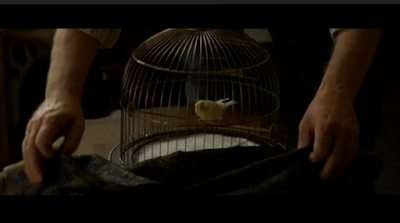
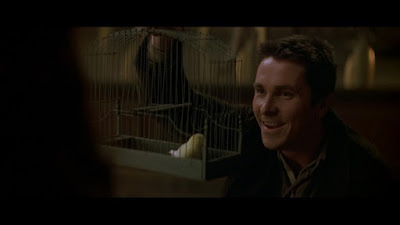
The Prestige is explored through the motif of cages. Throughout the film the
magicians, Lord Caldlow and Robert Bodern and his twin, perform a trick that
involves making a bird in a cage disappear and then reappear. When the trick is
being performed close ups, such as the bottom shot on the right, are used.
These close ups allow the audience to see what the magician is doing as they
attempt to figure out the trick actually works. This draws the audience in and
captivates them because they want to discover the secret behind the trick. This
is repeated throughout the film, allowing the motif of cages to develop. The
cages could represent the fact that both of the protagonists are trapped, much
like the birds, in a cycle of trying to destroy the other’s reputation. They
can’t escape this cycle and are forced by their own curiosity to understand the
mystery behind their opponent’s tricks. This makes them much like the audience
as they are desperate for information that they can’t receive until the end
when everything is revealed. The parallelism between the audience and the
protagonists is reinforced by the use of eye level shots because these shots
put the audience on the same level as the characters and allow them to identify
with the protagonists. Both characters are also trapped by their obsession with
their own stagecraft. They are never satisfied with their current act and force
themselves to create something bigger, better and more exciting. This results
in them losing their families and friends as they are consumed and trapped by
their desire to be the best. The cage is a key representation of how Caldlow is
trapped by obsession because at the beginning of the film he was unwilling to
kill a bird to complete the trick but by the end of the film he will kill
clones of himself just to be better than Bodern. This motivation and
determination is a common character trait for the protagonist in a mystery
thriller as they are driven by their desire to find the truth. For example, in
Gone Girl Nick Dunne is fuelled by the need to know what his wife has done and
why, leading him into her dark and unsettling past with other men. The use of
cages, as well as the bird trick in general, foreshadows the development of
more extreme versions of this magic trick that results in the death of numerous
clones emphasising the theme of mortality and bringing the value of human life
into question.
In The Prestige, sound motifs are also used.
Whenever either Bodern or Caldlow are on screen the score repeats a particular
phrase of music. These different sound motifs emphasise the difference between
the two characters and their separation now that they are competing with one another. The sound motifs of electricity and machinery are also used throughout the film to
highlight the importance of Tesla’s inventions in the film. These auditory
motifs also emphasise the relationship between magic and technology. This is
unusual because science and magic are normally separate and act to diminish the
belief in the other. Magic is also an uncommon aspect in most thrillers because
they focus more on the harsh and brutal reality of the world instead of the
mystic world of fantasy. The loud sounds of electricity and machinery as Tesla
makes his entrance are unsettling and set the audience on edge. This
establishes the idea that what Tesla is doing is disturbing and unnatural. It
also makes the audience uncomfortable when Tesla is on screen because they
don’t understand him or what his motives are.The combination of science and magic further confuses the audience,
however this also captivates them because, like the rest of the magic tricks in
the film, they want to understand them and how they work together.
Disguises are also a key
motif in the film, throughout The Prestige the characters use disguises to hide
their identity and to complete their tricks. These disguises further emphasise
the characters obsession because they can’t not know what the other is doing so
they have to go and watch them. It also reinforces the hatred and separation
between the protagonists because they can’t openly show their faces because if
they did the other would get angry which would lead to even more revenge plots
and investigation of each other’s trick. The disguises also relate to the theme
of identity which is a major part of the film. For example, Caldlow slowly
loses aspects of his identity and his feeling of self-worth as he continues to
let his clones die so that he can enjoy being in the limelight when the trick
is complete. It also relates to Bodern’s identity, this is because Bodern is
actually two people. Bodern is made up of two men who are twins that use their
identical appearance to complete their magic shows. However, because the two
men have to act as the same person it means that they lack their own identity
which negatively affects their relationships with others as they can never
truly be themselves. This could also link to the tricks throughout the film
because like Bodern they are never actually what they appear to be. The lack of
identity that both characters have could call the audiences’ own identity into
question and make them wonder what makes them themselves.
To
conclude, the motifs in The Prestige are used to reflect aspects of the
protagonists and to influence the audience’s views toward certain characters
and the way they act. The use of the bird cage seems to be the most prominent
motif in the film as it’s echoed throughout the film as are the ideas that it
connotes. It emphasises major parts of the characters, such as their obsessions
and how they are trapped and controlled by them. In our thriller opening we could introduce motifs that would be continued throughout the rest of the film, for example, our femme fatale always wearing an item of red could forebode danger and anger. This would be a subtle hint that would reoccur for the rest of the film.